

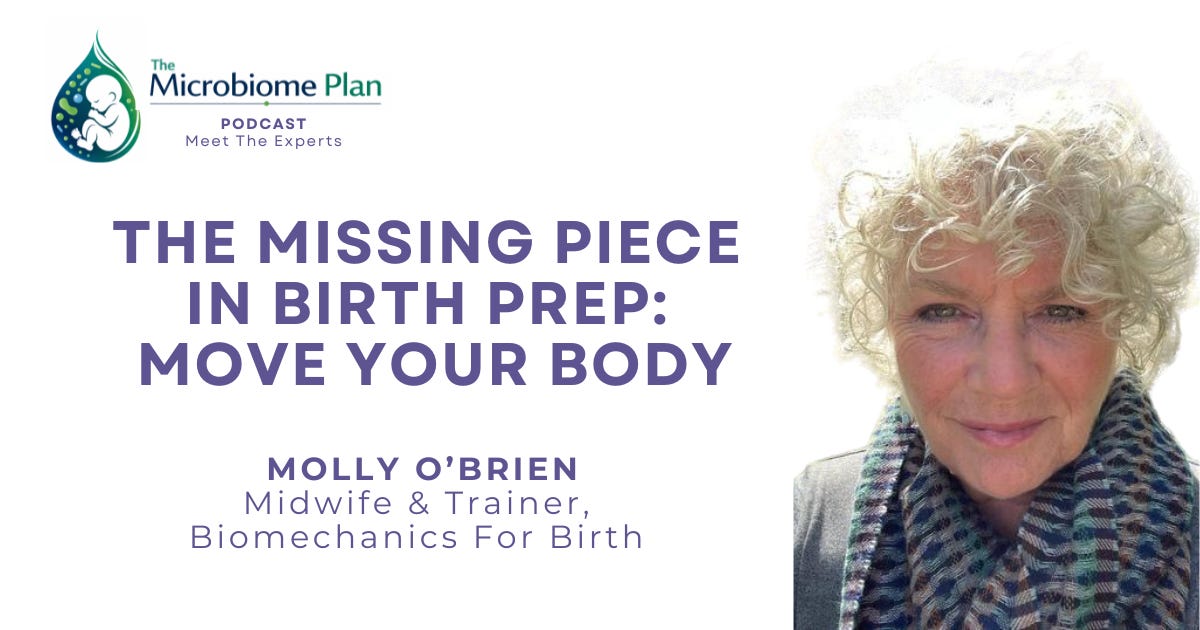
Why birth was never meant to happen lying down….
In this episode of The Microbiome Plan Podcast, midwife and educator Molly O’Brien reveals the “missing piece” in preparing for birth: to move your body!
Drawing on nearly three decades of clinical experience, Molly challenges restrictive birth practices, explains how movement changes pelvic dimensions, and highlights simple ways parents can better support their bodies during pregnancy and birth.
Take-Away Messages:
Movement during labour can help optimise pelvic dimensions and support physiological birth
Restrictive birth environments may interfere with instinctive movement during labour
Physiological birth supports the transfer of beneficial maternal microbes to the baby
Simple activities like walking, yoga, dancing, and using a birth ball may help prepare the body for labour
The pelvis is dynamic and mobile, not a rigid structure
Birth preparation should support confidence, mobility, and trust in the body, not fear and restriction
Small changes in maternity care environments could have a significant impact on birth outcomes and early microbiome development
Short Summary:
In this episode of The Microbiome Plan Podcast, midwife and educator Molly O’Brien explores why movement during pregnancy and labour may be one of the most overlooked factors in supporting physiological birth and optimal microbiome seeding.
She explains how modern maternity environments can unintentionally restrict physiological birth, while simple, low-cost interventions, like encouraging movement and upright positions, may improve labour progression and support the infant microbiome.
This episode reframes birth as a dynamic, instinctive process that deserves better understanding and support.
What Can You Do Today?
If you like this episode or find it useful, please share it with a colleague.
Subscribe to The Microbiome Plan podcast for more expert discussions reshaping how we think about health.
Want To See More?
Catch the replay Molly O’Brien’s presentation at The Microbiome Plan 2026 Conference. >>> https://microbiomeplan.com

Part of The Microbiome Plan podcast, exploring how early-life biology and environment shape lifelong health.
Episode Transcript
THE MICROBIOME PLAN – PODCAST
Meet The Speakers: Molly O’Brien
Molly O’Brien, Midwife & Educator, Biomechanics For Birth, in conversation with podcast host, and co-founder of The Microbiome Plan, Toni Harman
Molly O’Brien, midwife and educator, in conversation with podcast host, and co-founder of The Microbiome Plan, Toni Harman
00:00:00,120 --> 00:01:11,650 [Toni Harman]
[gentle music] Welcome to this tiny podcast about one of the biggest topics in health today.
Many parents write a birth plan, but how many have a Microbiome Plan?
Modern childbirth practices can interfere with the optimal seeding of the infant microbiome, with implications for a child’s long-term health.
But what does that mean? And what can parents actually do?
That’s the subject of our conference, and in this micro-series, I’ll catch up with some of the conference speakers to find out about their personal passions.
I’m your host, Toni Harman and in this episode, I’m joined by Molly O’Brien, a midwife with over 28 years experience in practice.
After a difficult birth herself, Molly devised a low-cost, but effective solution to help women labour more effectively, improving their chances of having a physiological birth.
This transfers the mother’s beneficial vaginal and gut bacteria to the baby, initiating the development of a healthy infant gut microbiome.
Let’s dive in.
00:01:02,600 --> 00:01:15,240 [Toni Harman]
With me today is an amazing, a fantastic person. In fact, I want to clone her and spread her wisdom around the world. This is Molly O’Brien. Hello, Molly!
00:01:15,240 --> 00:01:19,900 [Molly O’Brien]
Hi, Toni. Hi, lovely of you to say that. [laughing]
00:00:19,900 --> 00:00:21,910 [Toni Harman]
So who are you?
00:01:21,910 --> 00:02:30,460 [Molly O’Brien]
Well, I’m a midwife. I’m a midwife who had a difficult birth, my first baby, and I wanted to know, why does that happen? Why do we have d- difficult births? And it seems like um, does- that question’s not asked very often. Um, but we are trying to solve it by not actually understanding why it happens, and so that’s where I’ve been for a long time in the last... Oh, gosh, a well, since I’ve been a midwife. So I trained in 1996. Uh, had been a nurse before that, but I trained as a midwife in 1996, and I came in with that question in my mind. And I’ve been researching it and observing women giving birth and wondering why, and, and still getting information about it because it’s just building up now. It’s hard to find. Uh, but now getting a better understanding, and I want to tell everybody about that. So it’s about labour dystocia, difficult births, what causes it, and how the baby comes through this beautiful structure, the pelvis. So that’s, that’s what I teach about.
00:02:30,460 --> 00:02:37,280 [Toni Harman]
So give me an, an example of what you teach, how you teach it.
00:02:37,280 --> 00:05:19,978 [Molly O’Brien]
Well I’m, I’m teaching... What I learned was that when you move, [laughing] it changes pelvic dimensions. Um, you can open up a little bit more space in your pelvis. It’s kind of obvious, really, but there we are in the maternity field, where we have most women lying on their backs or semi-recumbent and or, or even in lithotomy, which is the legs up. And, and that does not help necessarily, unless women particularly choose that because they feel it’s right for them. But most of the time, no, it doesn’t. So I want to debunk a lot of things, but I also want to help everybody understand better how the body works. And I mean, there’s lots of things I could, We are talking quite big stuff, actually, Toni. You know, we’re talking about shifting mindsets. Um, but, but, but this one now, when we’re talking about the pelvis, for example, we often consider it almost like it’s a rigid structure, and it isn’t. It’s an articulated piece of architecture in our bodies that babies pass through, and it’s not just bony, but we’ll look at this right now. I’ve got the pelvis here. This is the sacrum. Here it goes. It moves. And even at the front, it opens up a wee bit more here ‘cause that is- has got, flexibility there, a wee bit. So we can make changes of these of pelvic dimensions just through movement, and I think this is really crucial that we understand that better. How does that move? And, and within that pelvis, there’s also fascia. Again, this is new stuff to us.
We didn’t know about fascia a, a few decades ago, or, or at least it wasn’t commonly known, and we’re getting to understand that better. We’ve got ligaments, um uh, we’ve got muscles and fibres, and a pelvic floor that we don’t fully understand. I know I’m jumping around here, but a pelvic floor, do you know what really gets my goat a wee bit, is saying it’s a hammock. Come on, a hammock? That’s what it’s described as, and it’s not a hammock. It’s a dynamic feature within our, um our, our pelvis, and it moves, so we need to start looking at that as well. So, that’s what I talk about. I talk about how this works, and it’s mobile. It’s separate bones.
00:05:19,980 --> 00:07:01,840 [Molly O’Brien]
You know, we get this idea it’s rigid. It’s not. It moves, and if we move, it moves as well. So yeah, I just love this. I am a bit of an an- anatomy nerd, and [laughing] I think it’s wonderful, and it’s it’s our bodies, you know? We should be celebrating it. Um, I, I mean, I, I could go on a wee bit more. [laughing] I could talk about, um the fact that we consider this shape of pelvis here, which is called a gynecoid shape pelvis, it’s a specific kind of shape here. Um, how the baby traverses this pelvis and the ada- adaptations it makes through this pelvis is related to its shape, but not everybody has that shape of pelvis.
And this has come from a study or studies from almost 100 years ago, that were not correct, actually. And we need to keep- get up to date with that and actually understand that we have different shapes, and that means it’s reflected in the mechanism, how the baby travels through, and that’s reflected in the patterns of labour that we see. And we have normalised this, only this shape as being the best one, and that is is not good. It’s not good to do that. So we need to widen our sphere of understanding, and I actually... Do you know what? I don’t, I don’t need to know what shape of pelvis you’ve got necessarily. What I do need to know is, are you having difficulty?
00:07:04,087 --> 00:07:10,087 [Toni Harman]
So what can health professionals do to support any shape of pelvis?
00:07:10,087 --> 00:10:45,728 [Molly O’Brien]
Yeah. They need to make sure, because again, let’s, let’s, let’s just think about this. This is the mechanical element of birth, that we have it’s been in the domain of the, of obstetrics. So it’s pathologized, and that’s a challenge in itself. So, so what we’ve now got in our birth rooms is being ignorant of how this moves and how wonderful it is, and we are restricting women in the birth room, so they’re not moving. Women don’t move in the birth room, not unless they’re in a midwife-led unit that is specifically set up to support physiology, and that’s where I was going with this. We’ve got the mechanical element, but it does not sit alone. We are not mechanical bodies. It is a part of our... the system the process, but we have got everything else, and it’s all connected. We’ve got the, the, the hormones, the mind, and the emotions, and the physical and the mechanical element, too.
So what midwives do, and it’s our, our, our profession is grounded in this, of physiology. How do we support and optimize physiology is very much part of our remit. So when you have a midwife-led unit, it’s the birth environment set up to provide that support, and that means there’ll be a birth ball there. It means the bed will not feature in a central way. We, we do like a bed, ‘cause we need a wee lie down from time to time [chuckles] and comfort, but it’s not a central feature.
Whereas in where most women are giving birth, in hospitals, it’s the bed is the central feature, and technology, and machines, and you’re probably attached to a machine, and you are restricted, and you can’t move, which means this can’t move. So we’re causing problems. So I want everyone to understand it is your right to have movement in the birth room. It’s a human right to be able to move, and in birth, I think. [chuckles] Um, and, and, and, and, and that’s the plan A, [chuckles] is to make sure everybody understands how important that is. It’s not just a wee thing, it’s a big thing. Move. Help yourself. Listen to your own body.
You know, Toni, I do say I say this is our... The top of what we need to do is to, to, to provide an environment and then where women can move instinctively. And I say that so easily. It rolls off the tongue so easily, but yet so hard to achieve for the p- for the reasons I’ve just spoken about, the restrictions in the birth room, but also how women feel about themselves, about their own ability to give birth, and that’s been influenced by media, by a cultural belief that we can’t do that. It’s too hard. It’s too risky. Um, and, and actually, it’s not, but we need that education to remind ourselves we can do that.
00:10:48,348 --> 00:11:02,328 [Molly O’Brien]
So it’s, you know, there’s a lot of a lot of different factors. It’s kind of simple, but it’s not straightforward [chuckles] because of those elements.
00:11:02,328 --> 00:11:10,887 [Toni Harman]
How would you encourage a laboring person to move? What can they do?
00:11:10,887 --> 00:12:58,308 [Molly O’Brien]
I would encourage them to, um... [exhales] I would, I, I would start in pregnancy and, and, and let them know that move- moving feels good. Dancing. Dance and move around. Get to know your body a little bit more. I think we’re kind of disconnected, you know, from our bodies, aren’t we, Toni? We- we’re on the screens, and, and this is something we all know. You know, our, our our society has changed. We’re all on phones and screens. We have a sedentary lifestyle. But get up and move. Move your pelvis. Feel what that feels like. Sit on the ball. Move. Um, do yoga. And, and once you start moving and understanding and feeling your body, you are more likely to do that in the birth room. And a birth ball is a very, very simple tool to use. Sit on that and move your pelvis. I’m going to say right here now, and somebody- anybody who wants can, can, can, can say, can correct me, but I don’t really see an awful lot of point of bouncing up and down.
[chuckles] I don’t see any point in that at all, except for it maybe being a bit in... You know, if you like it, and it feels good. But really, if you want to be moving this beautiful structure here and keeping it mobile, so it doesn’t get stuck, because it can do, ‘cause of, of various reasons. I haven’t got time to go into that, but it can get a little sticky, and we want that to keep on moving and being able to open up for your baby to come through. Sitting on a birthing ball and moving in certain ways can enable that to happen more easily. So that’s what I’m going to be talking about, actually, in the workshop at the conference.
00:12:58,308 --> 00:13:04,608 [Toni Harman]
So what are the take-home messages you would suggest?
00:13:04,608 --> 00:14:57,568 [Molly O’Brien]
The take-home message is, straight off, um uh, is-... do things in pregnancy that are gonna keep you be mobile. Move a little bit, and it doesn’t mean you have to go to the gym or anything like that. It just means walk, get up. If you’re a- if you sit in the... If you’re an office worker, get up every half hour or 45 minutes or so, and just move around a little bit. Be aware of your posture. How are you sitting? Are you slumping? Are you tucking your tail in?
You know, ‘cause we do a bit of that, too, don’t we? So, p- be aware of your posture. Sit up a little bit on your sit bones, your bum bones, which are down here, and you can put your hands under that and feel where they are. Sit up on them, and, and, and, and be aware of how you’re holding yourself. I would, if you could, do some yoga, some stretching.
We actually have evidence that that will help you in labor, that it actually reduces the perception of pain. It reduces the length of labor. We have got a lot of good evidence that supports these activities. Um, in the NHS, actually, in the UK, we’ve actually got a poster that has been created by the chief medical officer, and it’s all evidence-based. Walk, dance, do some yoga, swim. Do the things that you enjoy, you know? It doesn’t have to be hard. You don’t have to... Don’t make a meal of it. Just, just move around. Get up and have a wee dance. Get your favorite music on, and to me, that is really important. I feel that we will- because that can shift things in your own head about moving.
00:15:57,568 --> 00:15:31,928 [Molly O’Brien]
Do you know women actually reduce their activity totally when they’re pregnant? They actually reduce it. Now, I don’t know whether that’s because they’re uncomfortable or whether they’re a wee bit afraid, and they’re not quite sure about what to do. Um, but if you move more, you will become a little bit more comfortable. So get out there and go for a walk. Every day have a little walk. Get up and dance. Every day have a dance. It’s that simple, and that’s what I would say: Move. That’s my take-home message.
00:15:32,188 --> 00:15:46,047 [Toni Harman]
I completely agree with you, ‘cause there’s so much evidence about movement and the microbiome and how it’s all connected. And it’s all really important. How can someone find out more about you?
00:15:46,048 --> 00:16:51,488 [Molly O’Brien]
Well, I have a website which I have slightly neglected, ‘cause I’ve been teaching so much, [laughing] but there’s still quite good information there, and it’s www.optimalbirth.co.uk. So I’m teaching a lot of healthcare professionals. I teach doulas, obstetricians, midwives, um birth preparation instructors, ‘cause women need to know about this information, and their partners. Um, and I’m, at the minute, tr- trying to transfer everything onto a more, an easier platform. I do sit in front of the screen. I sit h- I sit too much, [laughing] um, but, um I’m trying to avoid, um uh, move away a little bit from that and do self-directed learning and modules, and so people, everybody can understand the, what goes on in childbirth and celebrate it rather than pathologizing it and seeing it all as very risky.
00:16:51,488 --> 00:16:55,146 [Toni Harman]
Thank you so much for sharing your wisdom. You are amazing.
00:16:55,148 --> 00:16:59,068 [Molly O’Brien]
Thank you so much. [laughing]
00:16:59,068 [Toni Harman]
I love Molly’s take-away message, to encourage everyone to be a bit more mobile, but particularly in pregnancy. Whether that’s going for a walk, a swim, doing some yoga, bouncing on a birth ball, or having a dance.
As Molly says, once you start moving your body in pregnancy, you are more likely to do that in the birth room.
If you found this valuable, share it with a colleague and subscribe to The Microbiome Plan for more conversations to help shape the best possible future health.
Thanks for listening.